How to read a Southern Cross Astronomical clock.
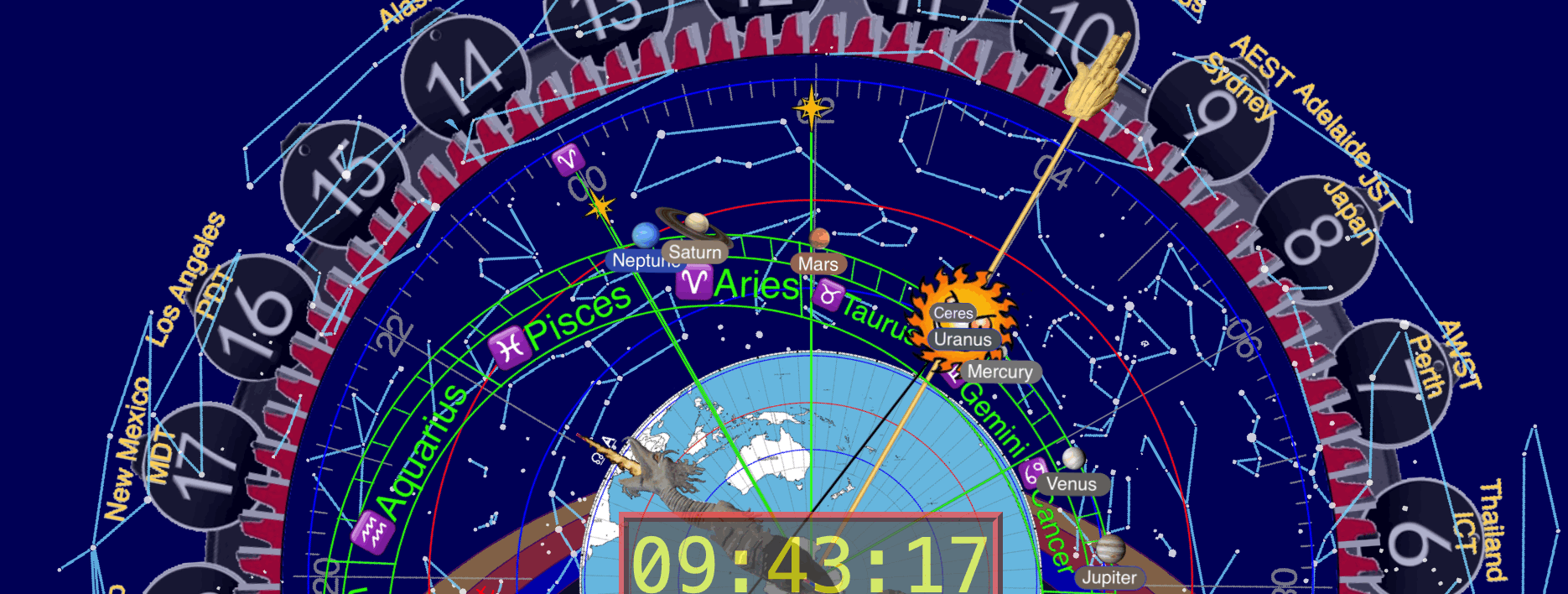
The Sun hand moves around the clock face in a 24 hour period following the natural movements of the Sun over an entire year. The anticlockwise direction is the direction
of the Sun in Winter while looking North where the Sun rising in NE and setting in NW is anticlockwise as viewed from the Southern Hemisphere.
The opposite is true if you live in the Northern Hemisphere while looking South which is why clockwise is the norm for standard clocks.
In the centre of your timezone the Sun is at its highest point at 12noon only at 4 points of the year, the rest of the time the Suns highest point can be almost
15mins ahead or behind the mean time set by your watch. The difference you see on a simple sundial and the standard mean time we follow today.
Moving away from the centre of your timezone to the edges can also add 30mins difference to the sundial time and standard mean time often
with daylight savings time added for good measure.
For this reason the numbered dial is not fixed but moves to accommodate your position in the timezone and natural changes in the Suns postion throughout
the year so the sun hand continues to point to the correct mean time we know as correct local time.
The Sun Image moves to the end of the hand during the peak of the Summer months and returns to a low point on the hand in Winter by following the green circle of the Earths Ecliptic,
set as the difference in the Earths tilt to its orbit around the Sun.
Moving the Sun from the blue outer circle of the Tropic of Capricorn to the blue inner circle of the Tropic of Cancer. The red circle in between is the Equator the Sun crosses
during Spring and Autumn.
The Green Ecliptic ring is divided into 12 equal sections labeled with the signs of the Zodiac.
In modern Astronomy Aries is the first 30deg arc or 0 to 2 hour of Right Ascension(RA) around the
Celestial Equator with Pisces as the last 30deg of arc or 22 to 24 hour of Right Ascension(RA).
The 0 point is set by the Suns position on the Celestial Sphere when the Sun crosses the March equinox on the Earths Equator.
This fixes the Zodiac ring to the Earths seasons before being projected out as a way to pin point objects in the night sky.
This is fine over small time periods but axial precession of Earths poles will see them circle the stars over 26,000 years adding drift to the stars recorded positions.
A good example of this is the Southern Cross known by the Ancient Greeks as Crux, where Ptolemy regarded them as part of the constellation Centaurus.
They remained entirely visible as far north as Britain in the fourth millennium BC before axial precession moved them ever closer to the Celestial South pole of today.
Modern Astronomy is now using The International Celestial Reference System (ICRS)
where the 0 point is fixed among the stars using the measured positions of extragalactic sources (mainly quasars) removing the Earth
as a reference point. As a start point of J2000 January 1, 2000 it was as close as 15secs Right Ascension(RA) to the Zodiac start point but will
drift away from the Zodiac with the removal of Earths axial precession on its fixed position.
While the Sun will take a Year to circle the Green Ecliptic the Moon will do it in 1 lunar month passing over the Sun as a NEW MOON before returning to the opposite
side as a FULL MOON.
- A synodic month is 29 days, 12 hours, 44 mins and 2.9 secs.
This is the period of the lunar phases we follow on the calendar for example one NEW MOON to the next.
- A sidereal month is 27 days, 7 hours, 43 mins and 11.6 secs.
This is the period of the Moon circling the Zodiac ring to the same star position. Following the Moons
position against the stars is practised by Middle East, India, and China cultures.
- A draconic month is 27 days, 5 hours, 5 mins and 35.8 secs.
The name draconic refers to a mythical dragon, said to live in the lunar
nodes and eat the Sun or Moon during an eclipse. Although the Moon orbits the Earth very close to the Sun-Earth Ecliptic a 5deg tilt will see the Moon 5deg above or below during
most of its orbit. The dragon hand points to the two crossing points known as lunar nodes where the Moon ascendes or descends through the Ecliptic. The Sun lined up
with one of these nodes will see a passing NEW MOON(solar) or FULL MOON eclipse.
Equatorial Coordinate System, Sidereal Time and Right Ascension(RA)
Just inside the clocks Topic of Capricorn in grey numbers and marks are the Right Ascension(RA) markers for the stars position around the Celestial Equator.
These are numbered 00 to 23 with 00 being the March equinox on the Celestial Sphere and is read out as Hours Minutes and Seconds of Right Ascension. The distance from
the Equator is the same as Latitude on earth and is read out as degrees arc-minutes and arc-seconds of Declination, ranging from +90degree North to -90degree South.
Local Sidereal Time(LST) is the value of Right Ascension(RA) at the High Noon point(the observer's meridian) at your location. The Clock has a fixed Gold star pointer at the top of
the clock near the Topic of Capricorn, the value of the Grey Right Ascension(RA) numbers at this point is your Local Sidereal Time.
A Sidereal day is 23 Hours 56 Minutes and 4.0905 Seconds. The time it takes for the Earth to complete one full turn against the stars. This makes 366.24 rotations per year.
Since it is not feasible to publish tables for every longitude, astronomical tables use Greenwich sidereal time (GST), which is sidereal time on the Greenwich, or Prime meridian.
The Clock has a second fixed Gold star pointer over the Prime meridian on the West side of Africa pointing to Greenwich sidereal time (GST).
The Gold Star pointer next to the Aries pointer is the Earth rotation angle (ERA), measures the rotation of the Earth from an origin on the celestial equator
and will replace the March equinox (Aries start point) in modern measurements like Sidereal Time.
Ecliptic Coordinate System
The Ecliptic is an important reference plane and is the basis of the ecliptic coordinate system. Ancient scientists were able to calculate
Earth's axial tilt by comparing the angle of the ecliptic (about 23.4°) to that of the equatorial plane.
From antiquity through the 18th century, ecliptic longitude was commonly measured using twelve zodiacal signs, that are 30° longitude each. Longitudes were specified in signs, degrees, minutes, and seconds.
The movement of planets, Sun and Moon in our solar system and the unexplained nature of these movements around the Ecliptic plane was the main topic of Ancient Astronomy.
Longitude is measured positively eastward 0° to 360° along the ecliptic from the March equinox, the same direction in which the Sun appears to move.
Latitude is measured perpendicular to the ecliptic, to +90° northward or −90° southward to the poles of the ecliptic, the ecliptic itself being 0° latitude.
The Ecliptic circle on the clock is divided by 30° along the Ecliptic but vary in angle size when laid out on the clocks Equatorial plane view point as shown
in the following table.
| Sign | Ecliptic angle | Right Ascension in degrees |
| Aries | 0 | 0 |
| Taurus | 30 | 27.910550 deg |
| Gemini | 60 | 57.818741 deg |
| Cancer | 90 | 90 deg |
| Leo | 120 | 122.181259 deg |
| Virgo | 150 | 152.089450 deg |
| Libra | 180 | 180 deg |
| Scorpio | 210 | 207.910550 deg |
| Sagittarius | 240 | 237.818741 deg |
| Capricorn | 270 | 270 deg |
| Aquarius | 300 | 302.181259 deg |
| Pisces | 330 | 332.089450 deg |
Days of the week
The clock includes a week long calendar labelled with the Days of the week in Latin, Old English and modern English.
Under those it has the Classical planets that the days where named after.
2026CE
June28 | 29 | 30 | 1 | 2 | 3 | 2026CE
July4 |
| Name of the Day in Latin and Old English |
Sunday
diēs Sōlis
Sunnandæg | Monday
diēs Lūnae
Mōnandæg | Tuesday
diēs Mārtis
Tīwesdæg | Wednesday
diēs Mercuriī
Wōdnesdæg | Thursday
diēs Iovis
Þūnresdæg | Friday
diēs Veneris
Frīgedæg | Saturday
diēs Sāturnī
Sæturnesdæg |
| Related classic planet and Greek God to the named day. |

Sun (Helios) | 
Moon (Selene) | 
Mars (Ares) | 
Mercury (Hermes) | 
Jupiter (Zeus) | 
Venus (Aphrodite) | 
Saturn (Cronus) |
The word planet comes from Ancient Greek meaning wanderer. So a classical planet is any visible sky object that moved against the fixed stars and that included the Sun and Moon. Planets are ordered from slowest to fastest moving as they appear in the night sky.
Known as the Chaldean order they are as follows. Saturn, Jupiter, Mars, Sun, Venus, Mercury and the Moon. You may notice this is not the day order which is Saturn for Saturday than jump 3 places for the Sun for Sunday than jump 3 places for the Moon for Monday and repeat.
The reason is the Chaldean order of planets was used to label the 24 hours in a day. If we start with (1)Saturn as the first hour of Saturday. All the planets repeated 3 times will get us to hour 21. The 4th repeat of (22)Saturn, (23)Jupiter, (24)Mars brings the (1)Sun as the first hour of Sunday. It's from these planetary hours
that the day is labelled by the planet which dominates its first hour.